
 Astronomers in the months past have been beside themselves over the discovery of a star with a name resembling a phone number having erratic flickering. I didn’t think much of the news as I thought stars were meant to twinkle. Our kids are taught from an early age of stars twinkling and sing about it in a well-worn nursery rhyme. The star named KIC 8462852 is a mere 1480 light years from Earth. Not only does the star feature a boring name, instead of the more original Brobdingnagian Plasma Bubble 9, it has baffled scientists into spending lone nights twirling knobs on telescopes in bewilderment.
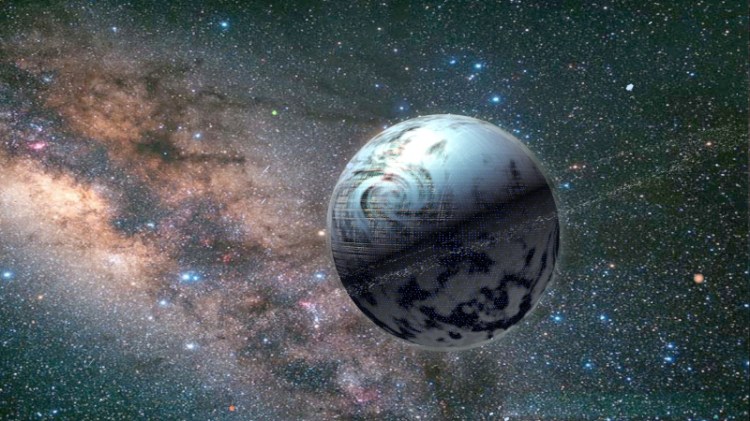
When a scientist suggested it was a Dyson Sphere, all agreed it must be a credible explanation. A Dyson Sphere has nothing whatsoever to do with cyclonic vacuum cleaners or Air Blades invented by James Dyson and found in public bathrooms, but rather the brainchild of Olaf Stapledon who created the concept in his 1937 novel ‘Star Maker’. As with many imagined creations, Freeman Dyson in the 1960’s decided the idea of a megastructure encircling a star to harvest the star’s energy is doable. The hypothetical megastructure may take many forms such as Dyson swarms, satellites in the stars orbit, or a more sci-fi image of a Dyson shell engineered from solid material encapsulating the star. An alien megastructure similar to the Death Star in Return of the Jedi (1983) sitting out there in space and feeding on the star’s energy could explain why the star lost almost twenty percent of its brightness since first observed. Disappointingly, I dialled the star’s name 543, 8462, 852 hoping to connect with an oriental soup kitchen only got a recorded message telling me, ‘Your call could not be connected, please try again’.
The star attracted the attention of boffins manning NASA’s Kepler space telescope and became excited, as much as anyone can be enthused after staring for years into the void of outer space, by the sudden dimming of KIC 8462852. The prospect stumbling upon an advanced civilization with technology bigger than Donald Trump’s hair sweep was exciting.
The SETI institute has been the ‘permanent ears’ to listen for alien signals and extraterrestrial intelligence for the past thirty years. Scientists pondered on whether the alien structure would fire laser pulses directed at Earth. Laser beams immediately conjure images of the walking aliens destroying mankind as they did in H. G. Wells’ War of the World. A laser pulse is different to a continuous laser beam. The record for the shortest laser pulse is four femtoseconds. I have no idea what it means but I will try to work femtosecond into future phone conversations from call centres.
Recent press releases from NASA has quashed the idea of intelligent beings building a superstructure around the star and believe the curious dimming of light is due to natural phenomena, asteroids and such. Apart from which, a signal from a distance of 1480 light years from earth to arrive today, would have been sent just after the fall of the Roman Empire. I like to think the aliens, being intelligent life forms, got sick of waiting for a reply and went home.
 ajhenryblog