
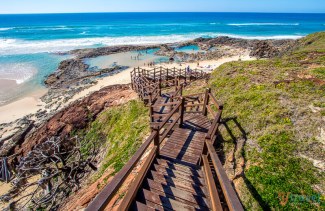
Last weekend I visited the same part of Australia the Duke and Duchess of Sussex were spending the day. The World Heritage listed Fraser Island is a place of natural beauty with long stretches of beaches and tumultuous rainforest. The national park which occupies most of the island is named K’gari, an aboriginal word meaning paradise. From the mainland, an expansive view sweeps across the Great Sandy Straits to take in the entire island. The Fraser Coast is one of Australia’s best locations. And yet, where I was, locals considered some parts hell on earth all because of rumours. I ventured there to find out if they were true.
Prior to this, I stayed in a suburb of the city and spoke to dozens of people about an area the Royals would tour on their way to Fraser Island. Each held the firm belief that one location on the coast was a place to stay well clear and avoid at all cost.
Rumours are stories about a person, place, or thing that are told to a wide audience of listeners. The main point about a rumour is that it is not a verified fact. For example, a rumour of a full moon is not a speculation to those looking through a window to see it. A full moon is a fact. For a story to get a circulation, people must believe it is important to them and could impact their lives.
Robert Bartholomew and Peter Hassall in their book A Colorful History of Popular Delusions define rumours as “stories of perceived importance that lack substantiating evidence.”
In 2013 one tweet created mayhem across world financial markets. It said an explosion in the White House injured President Obama. Another rumour centred on university students in Egypt staging orgies after buying chewing gum spiked with aphrodisiacs. Rumours implied the Israeli Government distributed the gum to corrupt the Muslim youth of that country. Shops were closed and arrests made, but they found none of the offending packets of gum.
With tales and tittle-tattle in mind, I wandered the quiet streets of a small village awaiting an attack of midges. Stories of the insects making life unbearable, indeed, uninhabitable for anyone living outside the confines of screened-off houses abound. Like all good gossip, there was credence to this rumour.
Irritating, biting midges exist in most countries of the world. Although not deadly, the bites cause hours of irritation. Atmospheric conditions must be in place for the hordes to attack: a still day in early spring or autumn, early morning or evening, close proximity to tidal mangrove zones. One lass working in the grocery store described infestations as ‘waves of attack’ so menacing it left little or no protection from the hordes. Rumours of the midge menace affected real-estate values making this otherwise spectacular stretch of coast unsalable.
On this day, the early morning conditions were perfect, sunny, windless and my unprotected arms and legs steeled for the assault. After half-an-hour walking through the manicured shrubbery and landscaped streets, I remained unbitten. A retired couple out for their morning walk told me tales of the biting pests were mostly myth. They cautioned that further down the hill towards the mangroves was an area for insects. I left the safety of the ridge and headed for the tidal flats.
A narrow path led the way into a large conservation area running parallel to the water’s edge. The path was empty–walkers avoiding the area and I suspect for good reason. After a further twenty minutes, I had no need to fended off a swarm, let alone one of the little blighters. My face, arms, and legs unblemished, not a nibble or gnaw, not even an itch.

Like the country of Lyonesse in Arthurian Legend, this peninsula, as with the lost lands that sunk beneath the waves off the coast of Cornwall, has sunk beneath the disparity and innuendo from those not living here.
An off-beam comparison, perhaps. But based on my experience, comforted in knowing the Duke and Duchess of Sussex as they passed by waving were not shooing sandflies.
 ajhenryblog