“Isn’t nature wonderful,” wrote award-winning author Richard Glover after observing trees on his property. A fire burned through the bush surrounding his house after the eucalyptuses survived a long drought. When the rains returned, foam oozed from the burnt trunks. It washed onto the soil and flowed to nearby creeks. Chemicals in the foam contain saponins—a type of steroid to help rainwater seep into the soil and aid new growth.
As wondrous as this may sound, nature awes not everyone. Former prime minister Tony Abbott made a “captain’s call” in 2015 while in office to delist 74,000 hectares of Tasmanian wilderness world heritage forest, despite caution from his advisors.
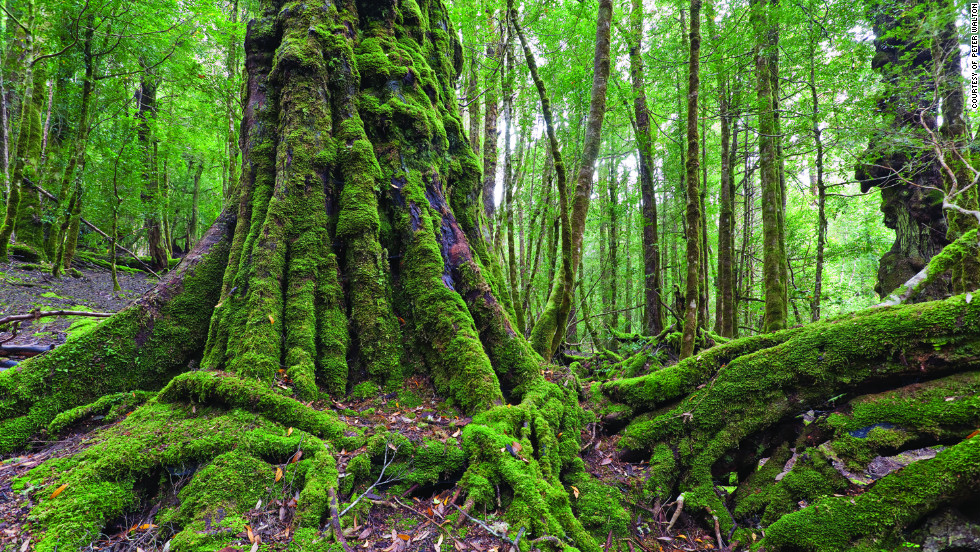
Moss covered trunks.
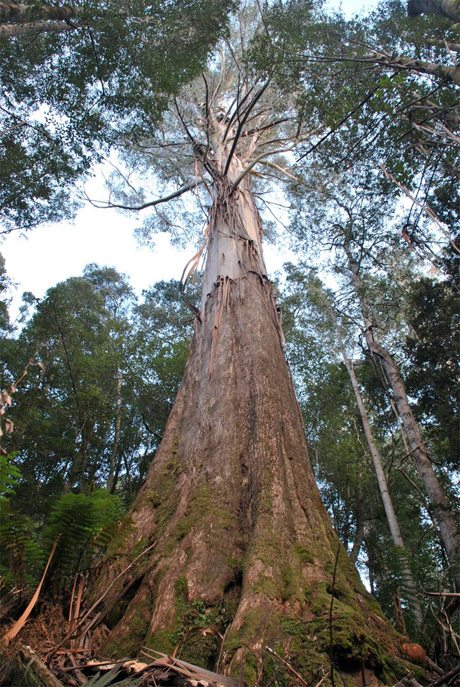
The Tasmanian wilderness largely comprises old-growth forests. Old-growth forests, or primeval forests, are unique places where the vegetation lay undisturbed for a great age. They typically have multi-layered canopies that provide a sanctuary for a diverse number of plants and animals.
Evidence from field-studies show old-growth forests are vast areas for storing carbon. As trees grow, they remove carbon from the atmosphere and store it in the trunks, stems and roots. Of the current forests on Earth, they estimate trees store as much as 45% of all land carbon. Old-growth forests do it better than young forests.
The island state of Tasmania has Australia’s largest old-growth forests around 1,239,000 hectares. Only 22% of the state’s original tall-eucalypts are preserved. Since 1996, ten thousand hectares of tall-eucalypt forests went to industrial logging.
Gunns Limited (the company closed in September 2012) was the biggest logging contractor in Tasmania. Australian opinion criticized the company for destroying old-growth forest to export as low-value wood chipping.
As for former prime minister Tony Abbott, he acted on an election promise to save thousands of jobs by delisting heritage forests. It would see tens of thousands of hectares open to logging companies. He enacted policy as do many democracies across the globe making short-term decisions with little regard for a future past the next ballot box.
*the Unesco World Heritage Committee rejected the Australian government’s bid to reopen forests in meeting in Doha.
Winston Churchill remarked in 1947, “No one pretends that democracy is perfect or all-wise. Indeed, it has been said that democracy is the worst form of government except all those other forms that have been tried from time to time.”
It is highly likely forests and the subsequent degradation of them is a casualty of democracy.
Book OneBook TwoBook Three
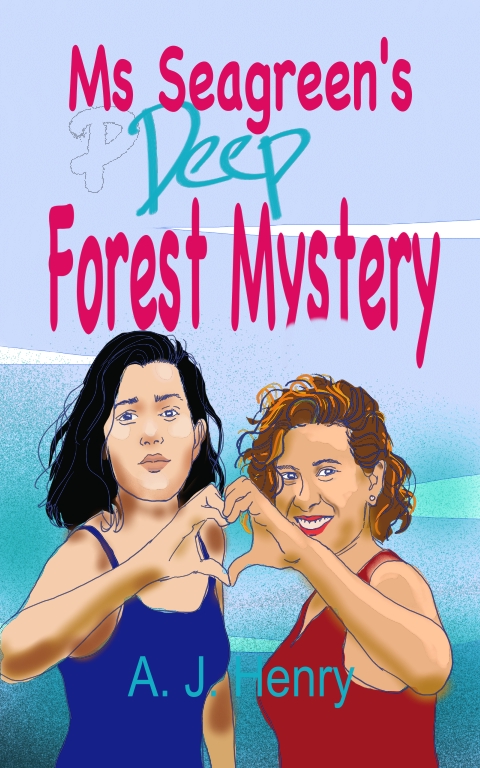
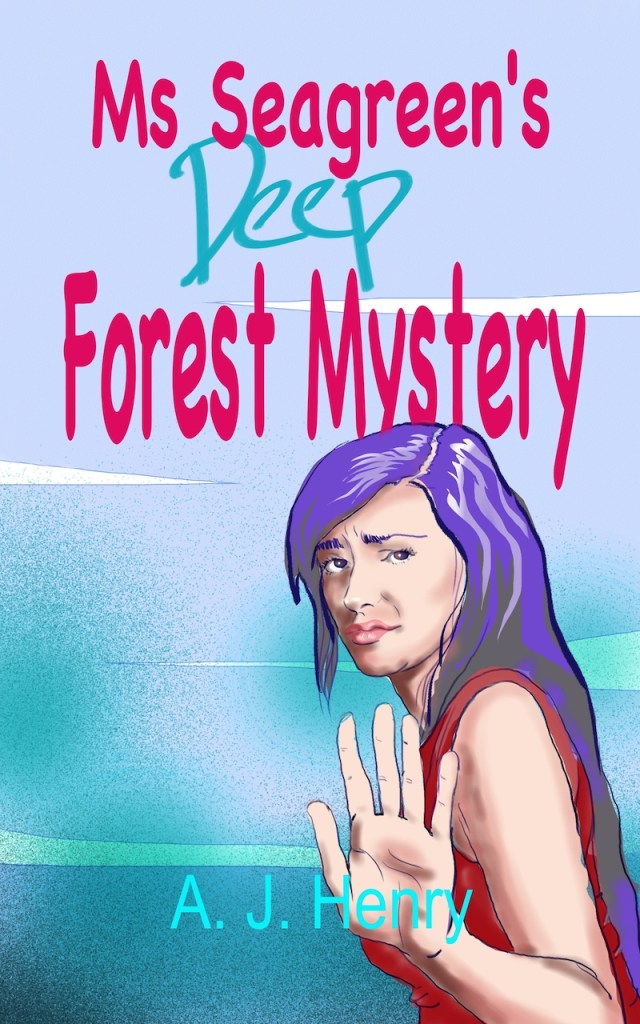
Ms. Seagreen’s Deep Forest Mystery is a cozy series set in a small town surrounded by old-growth forests in Tasmania.
“I love a sunburnt country/a land of sweeping plains/of ragged mountain ranges/of droughts and flooding rains.” A well-known poem published by Dorothea Mackeller in 1911. It depicts a land of extremes, a country that has endured bushfires throughout the millennia.
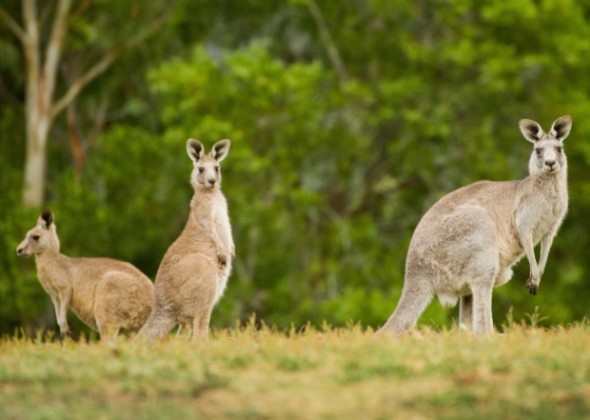
Kangaroos in the wild
Fast forward one-hundred-and-nine years to find that same country has changed.
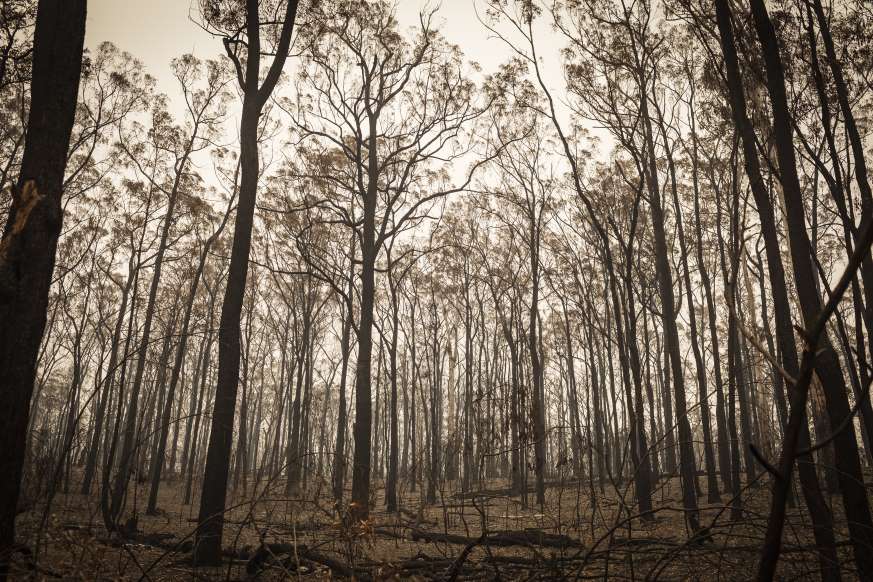
Scientists claim the summer of the 2019 fire is different from those in the past. These fires burned in areas which impeded large fires and acted as a natural barrier for protection.
Animals survived in Australia for a long time. The oldest fossil of a marsupial found in Tingamarra, Queensland, is fifty-five-million-years old. Could the unthinkable happen with many of these creatures facing extinction in their home habitat?
A Professor of Australian biodiversity at the University of Sydney, Prof Chris Dickman, co-wrote a report in 2007 for the World Wide Fund for Nature (WWF). He estimated every square of bushland roughly the size of a rugby pitch, or one hectare, was home to 17.5 mammals, 20.7 birds, and 129.5 reptiles.
The summer fires of 2019 burned ten-million hectares.
It is thought almost half a billion animals have died in the fires. But that figure could go much higher.
Worse still, this total does not include frogs, fish, bats, and invertebrates.
Larger species, kangaroos and emus could outrun a fire, unlike slower animals such as kolas, greater gliders, and potoroos. While larger animals may survive the initial flames, their future is of concern.
The long span of scorched earth is a habitat not found anywhere else in the world. The loss of hundreds of billions of insects is worrying ecologists. The invertebrates, which include butterflies, spiders, and earthworms, are vital for soil health and pollination, not to mention essential food for birds and marsupials.
If these habitats are destroyed, and the insects are gone, it is feared more animals will die.
The koala population is of the biggest concern. The arboreal marsupial and icon of Australia was hunted to extinction by fur traders in South Australia and Victoria. South-eastern Queensland populations have dramatically reduced by urban expansion. The largest colonies were in the fires zones of NSW.
Estimates put the number of koalas killed by fires at eight-thousand, but an exact figure will never be known.
The loss of human life, animals, and ten million hectares of natural habit burned in the fires is a crisis that will stay in the minds of Australians for generations
In 1996, gunman Martin Bryant shot and killed thirty-six people in Port Arthur, Tasmania. The mass-killing so shocked the nation that less than a month later, legislators introduced strict firearms control, including bans on fully automatic and semiautomatic weapons. Paul Bassat, a co-founder of the employment website SEEK, called the 2019 summer fires a “Port Arthur moment.”
Aggressive action similar to those enacted to gun-law changes in 1996 needs to happen immediately. Political leadership in both the Federal and State governments must see the uptake of renewable energy to reduce carbon emissions.
Dr. Schott, the chair of the Energy Security Board, told the Sydney Morning Herald and The Age, “Solar is generating more than gas, wind-generation more than brown coal. With all of that said, we are still burning a lot of coal.”
Back in 1988, the New York Times featured an article outlining a warning to the US Congress by James Hansen, director of NASA’s Goddard Institute for Space Studies. Hansen was 99 percent confident there would be a spike in global temperatures. He said of the increased levels of greenhouse gas that it would have, “Implications other than for creature comforts.”
Some thirty years later, Peter Harmer, chief executive of the IAG insurance group, released a report showing ‘the climate is changing more quickly than many predicted’.
During the last one-hundred years of this changing climate, ninety-six percent of the koala population has vanished.
The San Diego Zoo is by far the most successful breeding colony of koalas outside Australia. The Great Plains Zoon in Sioux Falls has another koala population. There are forty-nine koalas living in Japan and a further twenty in China. Edinburgh Zoo is home to the UK’s koalas.
A group called Koala Relocation Society is pushing for marsupial colonies to relocate in New Zealand with its thirty-thousand hectares of eucalypts. The group claim koalas are ‘functionally extinct’ in Australia while numbers could thrive in New Zealand.
Unless the current government takes decisive action to stop environmental degradation, the absurd notion that future generations of Australians must travel abroad to see their native animals could become a reality.
Featured photo by Chris Hopkins
A cozy mystery set in the old-growth forests of Tasmania.
A thick slab of beef browning in a skillet of oil could make way for braised quinoa or a tempeh confit. But don’t expect meat lovers to chain themselves to bridge pylons in protest. The conversion to a country of beany-boilers will arrive slowly, just as a warming climate crept unawares.
Gone will be the days when shoppers shook hands with beef, but join the queues of grass-holes and tree-huggers in the Republic of Vegantopia—formerly known as the misfortunes of accidental vegans.
Gundi Rhoades is a veterinarian caring for livestock in northern NSW for the last 22 years. In an article published in the Brisbane Times, she writes of the devastation she sees daily caused by a changing climate.
“Cattle that sold for thousands (of dollars) are now in sale yards a $70 per head,” she said.
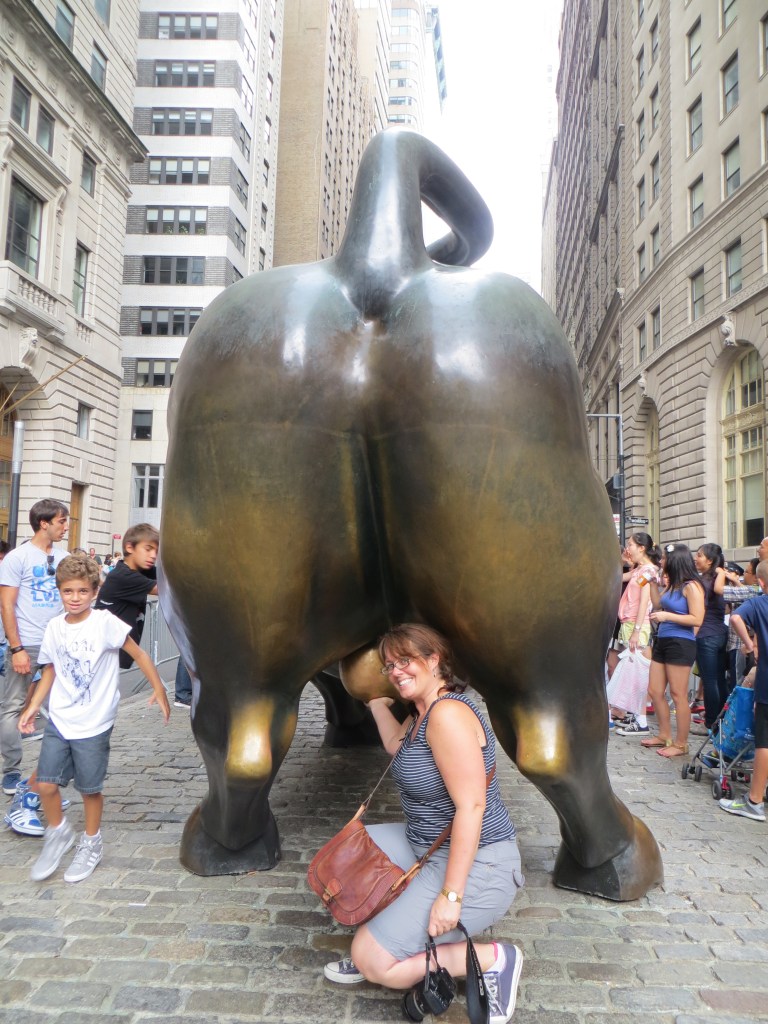
A tourist outside the New York stock exchange
Magnificent bloodline stock going for a song? It made me think what a fantastic marketing opportunity for a fast-food franchise: Not just a beef patty, but a pedigree burger.
The vet’s point is that bulls, or more specifically their unmentionables, are overheating in 40C/100F temperatures in what has in the past been a mild climate.
A bull with hot private parts can’t do what a bull has to do, which could mean cattle herds going the way of the dinosaur.
Rhoades went on to say about the prolonged hot and dry conditions in that part of Australia, “Piglets and calves are aborting.”
The vet’s point is that the food chain, especially the animal protein part, is deserting us and facing extinction from dinner plates. The finger of blame cannot be leveled solely at the rise of vegetarian Indian restaurants. A thing more sinister is at hand.
Meat Lover’s pizzas will disappear from menus as quickly as the Tasmanian Tiger vanished from a concrete zoo in 1936. A child of the future may ask the awkward question, “What is a meat lover?” To which the vegetarian parents scramble to Google or ask Siri to find a photo of a grease-stained menu.
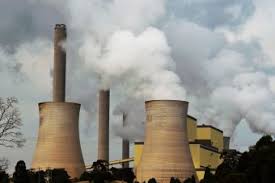
Thomas Edison, who invented electricity, was one of the first to raise concerns that generating electricity to power the light bulb could, to say the least, be a bit tricky. Perhaps he guessed back in 1930 that his invention would see hundreds of household devices needing electrical power from coal-fired power stations. These power stations pump CO2 into the biosphere, which in turn heats the atmosphere.
Billions of households sweating it out, cool down by turning up the air conditioner. More coal is burned to make more electricity to power the air-cons, but the Earth is heating up. The flustered masses drop the thermostat to notch up more cold air…and you get the picture.
By the 1990s, computer models predicted an increase in temperature of around 2C. Everyone thought, be serious! Two degrees ain’t so bad, it’s nothing.
What the computer models didn’t tell scientists because data entry clerk Maybell Rutledge from Jackson Hole Wyoming forgot to put a comma between mind-boggling big sets of numbers was, a warmer climate means hotter summers.
Hotter summers means less rain. Less rain plus hotter summers means the countryside bursts into mega catastrophic, really, really, really big firestorms!
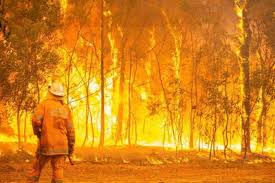
The world witnessed the tragic loss of uncontrolled fires.
The computers also forgot to mention that farm animals will die. One climate scientist did observe that menus in the future will offer big slabs of tofu on thin and crispy-crust pizzas.
Here in Australia, when large tracts of the country started to burn, politicians acted quickly booking Christmas holidays before queues got big at the airports.
One politician looked to the skies and declared the disaster was from a higher authority, and there is nothing we can do about it.
The current fires could be interpreted as God’s message much the same way he impressed Moses with a burning bush.
God, “Like, um, you better do something about this. And don’t even think to question the Lord.”
Mark Eggleton reporting in the Financial Review quotes the chief executive officer of the Clean Energy Council Kane Thornton as saying, “The technology’s proven, and we are seeing this around the world, so very clearly we can transition (from fossil fuel) much faster now than people had anticipated.”
This fire crisis in a country with no national energy policy makes Australians look like a mob of half-baked cow-pat kickers.
As the Australian Prime Minister Scott Morrison rummages through eggplant and lentils in a bain-marie in the parliament house kitchen hoping to find the last pork sausage to beef-up his flexitarian diet, he might think about renewable technology:
It changes as quickly as voters change their mind.
Imagine a situation where an asteroid of similar dimensions to the one that ended the dinosaurs is on a collision path with the Earth. Someone in the government decides it best not to tell the public. Their reasoning is it would create undue panic among the population and the electorate should be allowed to enjoy their last moments on Earth in peace. The information becomes a classified secret.
Contrary to this, if governments openly admitted their agencies were tracking an impending catastrophe, the world’s financial markets would plunge in free-fall: real estate, gold bullion, and currencies would instantly be worthless. Criminals would create havoc. Law and order abandoned. People would cower in fear of attending their place of worship due to violence in the streets. Having officials withhold information was best for all.
While it could be said keeping news about impending disasters from the populace has its merits, many would argue governments have no right to keep the public ignorant of the facts. In the face of a global disaster, individuals would not have the chance to say goodbye to loved ones. Life-long friends who recently fell out would not have the opportunity to make amends. Those with a wayward life could not make peace with their God.
While such a scenario sounds like a script for a Hollywood movie, could it really happen? The answer is, probably not.
The advent of whistle-blowers and widespread access to social media would spread the news of a deadly asteroid long before legislators could classify it.
Such a fictitious story line begs the question, why do governments keep some information secret?
Some examples of classified information are UFO sightings or plots to kill political leaders. The following are just a few examples of intelligence released to public knowledge.
Grand Central Terminal
A door to an elevator at the station is welded shut. It is now known that under the terminal deep underground is a network of rail tracks along with storage areas. President Franklin D. Roosevelt used the underground platform as a way to get into New York City and avoid the press. An elevator took the President up to the Waldorf Astoria hotel.
John Lennon spied upon
Historian Jon Wiener won a Supreme Court case against the FBI to release information they had about the singer. The Nixon administration in 1971 did not like Lennon’s anti-war protests. The popularity of songs such as “Give Peace a Chance” put him under the FBI radar.
Churchill and Eisenhower deny UFO’s
In 2005 the Freedom of Information Act was invoked in Britain. Files were released by the Ministry of Defense, claiming prime minister Winston Churchill ordered UFO sightings to be kept from the public to avoid mass panic. UFO sightings were so dangerous in the 1950s, UK intelligence chiefs held an urgent meeting to deal with the issue. UFO investigator Nick Pope said, “The interesting thing is that most of the UFO files from that period have been destroyed.”
CIA Mind Control
The US Central Intelligence Agency experimented with people from colleges, hospitals, and prisons to control their minds. With code names such as Project Bluebird and Project Artichoke, the experiments used mind-altering drugs such as LSD to weaken an individual’s will power and extract confessions. The CIA Director Richard Helms ordered the MKUltra files be destroyed in 1973.
Kill Castro
The CIA wanted Cuban President Fidel Castro gone. In 2007 documents that were declassified show the agency hired American mobsters Johnny Roselli, Salvatore Giancana, and Santo Trafficante to assassinate the Cuban President. The gangsters along with Al Capone were on the FBI’s ten most wanted list. The plan was to poison Castro’s food, but after several unsuccessful attempts, the plan was abandoned due to the disastrous Bay of Pigs Invasion.
Potemkin Village
During Catherine II’s journey to Crimea in 1787, her ex-lover Grigory Potemkin set up portable buildings along the banks of the Dnieper River to impress the Empress. Such deceptions have been used by various governments since. Nazi Germany set up the “Paradise Ghetto” to convince the International Red Cross that concentration camps were following the rules. Theresienstadt Camp became the way-station to Auschwitz-Birkenau. In Northern Ireland ahead of the 2013 G8 summit, photographs were placed inside the windows of vacant shops to trick passing visitors that the town of Enniskillen was thriving. President Donald Trump ordered his construction manager to hire dozens of earth-moving machines to push the dirt around at his proposed casino site in Atlantic City. He wanted to impress Holiday Inn executives to invest in the project by showing work was well underway.
Intelligence Agencies: Every country has one
Governments keep classified information for things such as Military plans and weapons, details about foreign governments, scientific technology relating to national security, safeguards for nuclear material, and weapons of mass destruction. Most countries have some kind of ‘burn bag’ to destroy classified documents that are regarded as Top Secret and too sensitive for public knowledge.
Smart Phone, Smart Home
Technology has introduced a range of options for the government to gather information about those who voted them into power. A growing number of people are suspicious of the governments’ use of technology and whether it is ethical. For example, if they use artificial intelligence programs that determine who qualifies for social security benefits. The law is increasingly concerned about private data used by companies without the citizens’ knowledge. Multinational companies are selling all-seeing, all-listening devices to consumers — televisions that hear what you say, software that tracks car owners’ driving habits. Toys are no exception. A series of well-known dolls listens-in on a child’s conversation and sends it back to the parent company. A site called Shodan searches for unsecured webcams and allows users to spy on households without the owner’s knowledge. Kiddie perverts eavesdrop into baby monitors while Nest thermostats leaked zip codes of the users’ location.
Silicon Valley critic Evgeny Morozov summed up smart technology in a tweet. “In case you are wondering what ‘smart’ means: Surveillance Marketed As Revolutionary Technology.”
With so many organizations spying on a population, should governments be more open about the secrets they keep and the amount of intelligence collected?
What do you think? Join the discussion in the comments below.
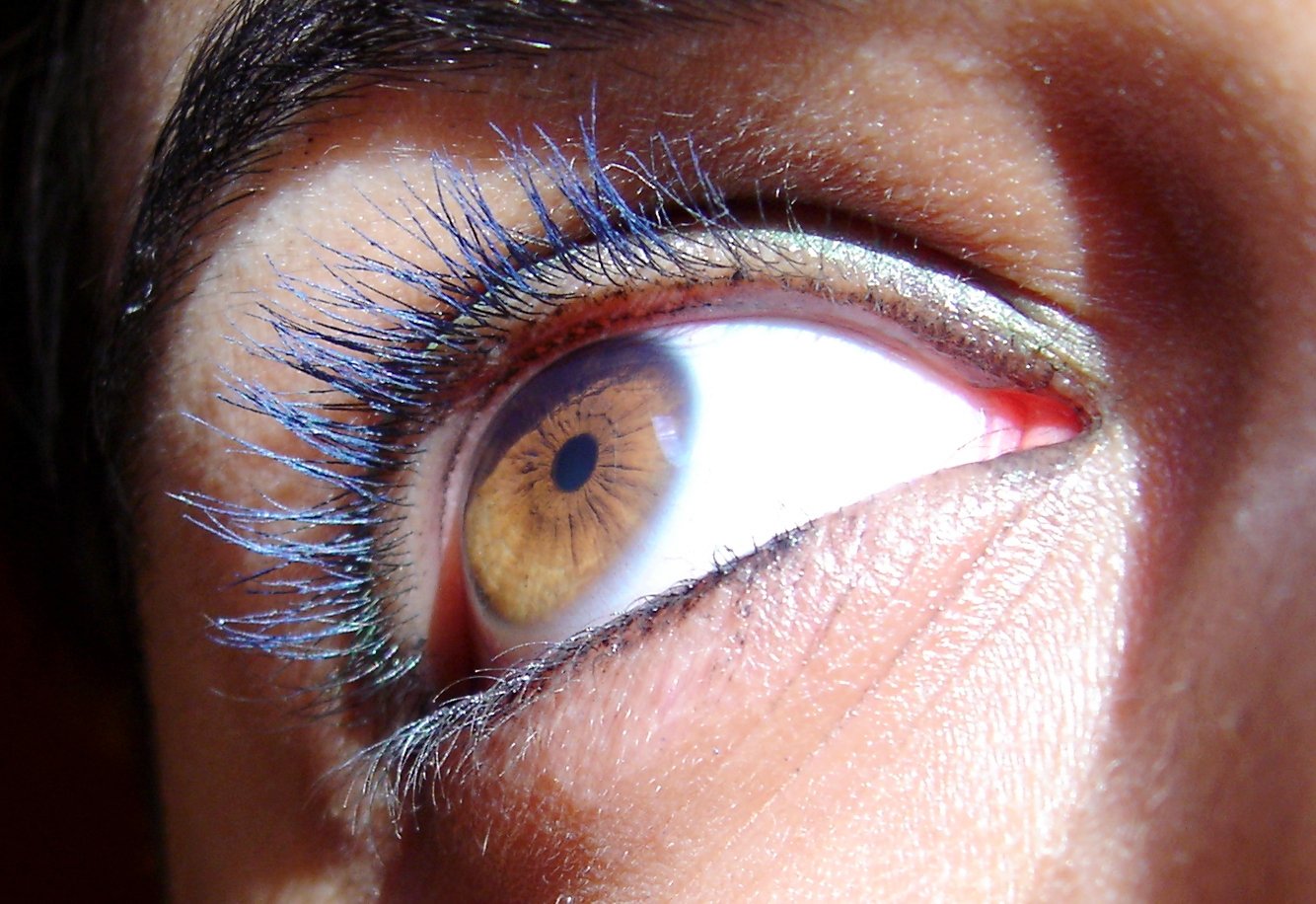
In the early centuries, those who committed a crime against the community was regarded as offending the gods. The gods would vent their displeasure in the form of floods or famine. The Bible says, lex talionis or ‘an eye for an eye and a tooth for a tooth.’ It means punishment for the crime should not spiral to personal revenge resulting in blood feuds but no greater than what befits the wrongdoing. Various societies sought ways to penalize criminals. Some, by today’s standards, seem bizarre and unjust. Here are just a few examples.
Ancient Egypt.
In the time of the Pharaoh Akhenaten, around 3,300 years ago, workers were brought in to construct temples and palaces for the sun god Aten. The laws were dished-out by the Pharaoh to stop wrongdoers from committing crimes such as theft. Most punishments were imposed upon the labourers.
Skeletons excavated from mass graves in 2015 revealed several things about the commoners living in that time. The vast majority did not live long, twenty-five years of age were old. Wounds to the shoulder blades on some skeletons confirm the Egyptian fable about the thief who stole an ox. The thief got 100 blows with a cane and five stab wounds to his back. Tax-dodgers were beaten while lying face down on the ground.
The penalty for grave robbing was an early death to their own grave.
Women did not escape punishment either. A woman committing adultery had her nose cut off to ruin her looks. If a man raped a woman, he was delivered a deterrent by swift castration.
The Roman Empire
Romans took census time seriously. The king of Rome Servius Tullius decreed everyone must take part in the citizen count to get an accurate record of every citizen’s property to ensure they paid tax. The punishment for not taking part in the census was the confiscation of all property and the citizen sold into slavery.
No record exists of this punishment being carried out. The famous lawyer Cicero records the punishment of Publius Annius Asellus, who did not turn up at census time to evade inheritance law as losing his right to vote.
Older men in Roman households held the law. In the paterfamilias patriarchal system, the oldest male had the power to kill anyone in the home. Quintus Fabius Maximus Eburnus killed his son after discovering his ‘dubious chastity’. The law did not allow the head of the household to slay members of the family on a whim. As sexual matters were not generally considered a crime, Maximus Eburnus was tried and sent into exile.
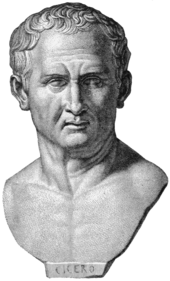
Cicero
A crime against the state was a more serious offence. During the conspiracy of Catiline whereby his followers got together to kill the consul Cicero, Aulus Fulvius was slain by his father for his part in the plot but was not prosecuted.
By far, the most bizarre sentence was poena cullei, ‘punishment of the sack’. Anyone who killed their father or mother or relative was a dastardly crime called parricide. The jurist Modestinus records that the penalty for someone committing parricide was sewn in a sack with a dog, a rooster, a snake, and a monkey. If that wasn’t bad enough, the bag was then cast into the sea. Historians doubt whether such punishment was carried out but rather a custom designed to terrify the populace.
Mosaics depicting ‘punishment of the sack’.
The Medieval Era
By far, the most inventive forms of punishment were inflicted in Medieval Europe and Britain. Many penalties throughout this era where ‘trials of ordeal’ whereby pain was believed to be the true way a person’s innocence or guilt. People living in those times had respect for those who endured pain. The brutal death of Saint Ignatius who was devoured by two lions at the Coliseum by orders of Emperor Trajan. Saint Andrew of Bobola was tied to a tree, whipped and tortured. Saint Catherine was sentenced to the ‘breaking wheel’, a popular form of torture in Europe from the Middle Ages to early modern period. A heavy cartwheel was dropped on legs and arms to break them. The body of the victim was them braided through the wooden spokes and decapitated. Many feast days are included in calendars honouring these victims of torture.
A woman in a ducking chair
Not all forms of punishment were brutal. Some criminals were forced to wear terrifying animal masks. Women often bore the brunt of chastisement. If a wife scolded her husband or spread village gossip, she was tied to a ducking stool. This involved a type of crane swung out above a river, and the woman ducked into the water. Similarly, the ‘scold’s bridle’ was a metal mask with spikes that went into the victim’s mouth to stop them from spreading gossip.
For petty crimes, the penance was served outdoors in the stocks. The criminal got locked by their feet, or by their head in a wooden yolk and left for public shaming.
A trial by ordeal saw criminals bound and thrown into the water. If they sank, they were innocent. If they floated, they were guilty. Being taken to the king’s court was the ultimate punishment. The offender was made to hold a red-hot ingot and walk three paces. After three days, if the criminal showed their scalds had healed, they were pardoned.
In Britain, the death penalty involved getting locked inside a human-shaped cage and left to die from exposure of dehydration.
The Breaking Wheel
The racks were a form of torture popular with inquisitors interrogating a person convicted of heresy in the Middle Ages. While the victim was questioned, the accused had their hands and legs tied to a rope attached to pulleys at each end of a rectangular bed. As the lines stretched, joints in the body dislocated.
The Judas Chair and the Spanish Donkey were also ways of slow torture. By far, the worst way to die as punishment for a crime was the Pear of Anguish. Long and slender, spoon-like segments of metal were enclosed around a screw to resemble a pear. Once the screw turned, the metal leaves open up. In Holland, robbers put the pear into victim’s mouths to stretch their throat and stop them from talking. In other countries, the pear-shaped object got inserted into orifices of the victim’s body. The Medieval Inquisitors used this punishment for the crimes of witchcraft, prostitution, and homosexuality.
Modern Punishment.
The United States of America is the only Western country to impose capital punishment. Public executions still take place in Iran, North Korea, Saudi Arabia, and Somalia. For most crimes, offenders are removed from society and locked up. The oldest form of punishment is retribution and is still in practice today. Retribution gives victims a sense that the lawbreaker suffered punishment. Almost the opposite of retribution started in the 1970s. Criminals are giving a chance to rehabilitate their ways and go back into the community. Yet another form of punishment sees the victim and offender tell each other their side of the story to make amends.
Although the threat of being sewn into a sack with creatures, scared citizens of Ancient Rome, some risks of punishment are at the forefront today. The much-reported case of Wikileaks founder Julian Assange is an example. Assange is held in prison, awaiting an extradition trial. If sent to the US, he faces a jail term of 176 years. Such severe punishment begs the question: did the journalist commit a crime worthy of the penalty? Journalists across the globe, regardless of international borders, will understand the threat of punishments should they expose dealings governments across all countries do not want the constituents to know.
To download interesting reads, click on the link below.
A television cop slams his or her hand on the table, looms over the suspect and shouts accusations. The withering suspect eventually confesses. High drama, great viewing, but is it how it really happens?
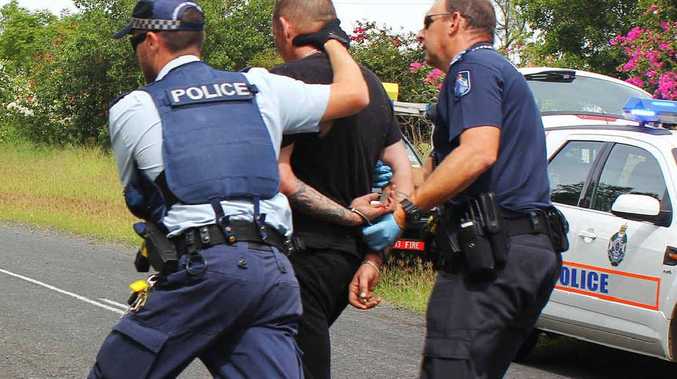
Police want what happened and who done it?
A look at how police talk to suspects and eye witnesses was instigated in the 1980’s. Subsequent research found that police in Britain either ignored the procedure or did not understand it. Training police in the methods for interviewing suspects, witnesses, and victims is based around four techniques.
In contrast to our television cops, police follow strategies that go against how we communicate. In every day conversation we ask questions we do not want fully answered, talk over each other, and do not listen carefully to what others say. Every time a police officer asks a question they stop the person interviewed from talking. Questions can also upset a witness or victim’s memory of events.
Police are now trained in cognitive interview techniques.
In reality, it is impossible to interview someone without asking questions. The open question is a way to get a person to say in their own words everything they saw ans heard, no matter how insignificant it may seem. Only the police can decide what is vital and what is not.
Context reinstatement questions are designed to get a person to picture in their mind exactly where they were, objects, and people around them. In a way, go back in their imagination to hear sounds and events going on at the time.
Another technique is called revers temporal order of recall. From an early age we develop a fear of the unknown. To cope with this, we invent stories about what happened to hold in our memory. By asking a person to recall what happened from the last thing they saw or heard at a point in time and remember backwards, unravels details lost in the original telling of events.
Changing perspective technique is a question asking some one to focus on one aspect of an event. All of us are for ourselves—we see, hear, and feel things in the way it impacts us. If asked to describe a situation from another view point, forces us to think and remember in a new way, to look at the bigger picture outside our own way of seeing. Such a technique has limitation and would not be used for certain crimes such as sexual assault.
Unlike our television law enforcement heroes, the most effective techniques to get information to help piece together the often complicated puzzle involving crime, is to shut-up and let the suspect do the talking.
Self-talk or inner speech is an inner narrative which gives a voice to our thoughts while we are awake. Dramatists use a monologue to tell the audience what a character is thinking. They sometimes use it to share information with the audience. But what of the stories we tell ourselves? Why do we do it and can they affect us?
For most of us, the answer is yes, and our story can impact everything we do. Tell ourselves a bad story and our life can be hell.
Introspection is the examination of our own conscious thoughts. It also involves a look at our soul in a spiritual context. For thousands of years people talked about the inner voice. Plato once questioned, “…why should we not calmly and patiently review our own thoughts”. Self-reflection is an image we have of ourselves and is hard to change. It comes from things learned about who we are.
Research has shown human brains can only experience one thought at a time as a fast-flowing streams. Buddhist scriptures describe it as the ‘Mind Stream’. Practicing mindfulness is being aware of the moment-to-moment events in our life and how we react. Buddhist teachings say the mental and material events created by the senses: seeing, hearing, tasting, touch, and thoughts is related to the past, present, and future.
In literature, the technique of narrating the flow of thoughts and feeling popping into the minds of characters is called stream of consciousness. Stream of consciousness is a literary device which gives the writer the ability to tell an audience or reader what a character is thinking. It can be a loose selection of thoughts in connection with how the person feels or reacts to something.
Authors however did not create the term, but coined by the eminent psychologist William James. Susan Blackmore, visiting professor, University of Plymouth describes it this way, “When I say that consciousness is an illusion I do not mean that consciousness does not exist. I mean that consciousness is not what it appears to be. If it seems to be a continuous stream of rich and detailed experiences, happening one after the other to a conscious person, this is the illusion.”
We know a negative self talking story is involved with psychological disorders such as low moods affecting how we behave, and our sense of well-being. It can also lead to a sense of dread and turmoil resulting in lose of sleep.
The stories we tell ourselves develop from things that happen in the day-to-day from childhood to the job we had last week. The time when the teacher yelled at us for crayon scribbles on the wall, even though we didn’t do it, set-up ‘automatic thoughts’ which get repeated over and over as a view of ourself and the world around us.
A bad story can also come from wanting to do something perfectly. All of us have a choice in how we live and the story we tell. It is entirely possible to kick back and do nothing, live a happy life of unchallenged bliss? Probably not. A tiny voice would rehash saying such as life is not a rehearsal, or time waits for no man to remind us our story of doing little or nothing is no story at all. Most of us want to do something, take a challenge, leave statements of the minutes, hours and days of our existence.
Attempting to do something—such as write a blog—opens up the possibility of failing. Failure is inevitable. It is how we tell the story of what happened in those dismal times of defeat that makes the difference. We can distort a bad story after a failure into something like, I’m the dumbest that ever lived. Such a story is not true and a method of arguments called elenchi would cross-examine the facts to disprove the bad story.
We’ve all read stories of epic failures by famous people. Stephen King was working as a school teacher when he wrote Carrie. After getting his novel rejected 30 times he did what Homer Simpson advised, ‘If at first you don’t succeed, give up before you fail again.’ King tossed the manuscript into the trash. His wife convinced him to submit it one last time.
Thomas Edison said, ‘Many of life’s failures are people who did not know how close they were to success when they gave up.’ That could have been Stephen King’s story. Edison who endured many failures turned the story he told himself around. He said, ‘I have not failed. I’ve just found 10,000 ways that don’t work.’ His life story had the hallmarks of being a bad one. While at school, his teachers assessed him as pretty dumb and would not likely succeed in life.
Back in an era called the ‘swinging sixties’ people became fascinated with the capabilities of the mind. Some took drugs called hallucinogens to cause them to see, hear, and feel things that weren’t there—experiences only in their head. It opened questions about reality and how we deal with it. At the same time psychiatrist Aaron T. Beck started to believe thoughts, feeling, and behaviour are all associated. He came up with the idea that if we want to do something and overcome obstacles along the way, we have to change our thinking. It set the basis for what we now know as Cognitive Therapy.
Here’s the thing: many of us don’t recognise we have bad thoughts or stories. There are four basics steps in what we call Cognitive Restructuring: the first is knowing we have bad stories that are negative about us and the world around us. The second is understanding these thoughts are distorted and we must do something about it. The third is cross-examining the story to disprove it. While the fourth is coming up with a good argument that these automatic thoughts are bad.
If we want to be better, tell ourselves a better story.
I’m part way through a university course on Forensic Psychology. For those who don’t know and too afraid to ask, forensic psychology is the study of how we observe and recall detail, in particular, witnessing a crime.
To give you an idea of how we see, a video showed a group of people in an office all wearing white. One holds two green clipboards, another holds two red ones. We were asked to count the number of times the red folder held in a person’s left hand was passed about. The group circulates in random patterns each passing the folders from one to the next.
The video was based on a study conducted by Simons and Chabris in 1999 called ‘a gorilla in the midst’. I was pleased with my powers of observation counting the correct number of times the red folder changed hands.
The instructor then asked if we noticed the giant mouse? I thought, bulls**t! How could I miss something like that? On replaying the video and this time ignoring the clipboards, sure enough, a person in a mouse costume walked into the middle of the folder passing scuffle, stopped, waved to the camera, then continued off screen.
What kind of shamanism was this?
It turns out I’m not alone. Well over half of the people given the same test failed to see the giant mouse. Psychologists call it unintentional blindness—failing to catch the bleeding obvious. It turns out, we observe what is happening and our brains process it, but we do not attend to it and so not conscious it is there.
It started me thinking if similar processes are at work when we write?
Take, for instance, the old bugbear corrected by editors, wordiness: adverbs stuck to the ends of verbs like a hideous rat’s tail, or should I say, giant mouse tail. Adverbs limit or extend the significance of a verb and qualifying adjectives and other verbs. Stephen King does not like them. He says, “The adverb is not your friend.” King concedes adverbs have a place in dialogue attribution but only on special occasions. He likens adverbs to dandelions—one on your lawn is pretty. Ignore it and soon your yard is covered and you will see dandelions for what they are, weeds.
Stephen King is not alone in decrying wordiness. Raymond Carver wrote about lessons from his teacher John Gardner, “… wanting me to understand what he was trying to show me, telling me over and over how important it was to have the right words saying what I wanted them to say. Nothing vague or blurred, no smoky-glass prose.”
So why do we overuse adjectives and adverbs? Possibly, or invariably, and other ‘ly’ words it is in haste, the fear we have in converting our abstract imagination into concrete words. Getting our stories down before they fade into distractions of the everyday, grabbing dull verbs in place of strong ones. Then again, it could be like the giant mouse walking through screen—our attention is elsewhere in the complexity of storytelling and we don’t see them.
An ISBN allows libraries, booksellers, and readers across the globe to find your book. It is the Bowker identifier service that gives your book a unique number stored in a database. People search this data when looking for a book—someone-hundred million.
What Do All Those Numbers Mean?
The first number identifies the language of the book. When you see an ‘0’ or a ‘1’ it means the book is in English. ‘2’ identifies the French language, ‘3’ German, and so on.
The next group of numbers identifies the publisher and the number of ISBN’s they own.
Coming after the dash is the ‘title identifier’ to tell the publisher if it is a soft or hard cover version or an EPUB edition.
The last digit is a check number to mathematical calculate if the rest of the ISBN was correctly scanned.
Since 2007, the format changed to add ‘978’ as a prefix to create a 13 digit string of numbers, see the example below.
ISBN:978-1-64370-710-5
Language: English, published by A J Henry. Title: Missing Murder Mayhem. EPUB edition.
If your book is printed in either soft or hard cover and sold in bookstores, it must also have a barcode.
ISBN title data is listed in ‘Books in Print,’ a service used by commercial buyers. The identifying data must register each version of your book: EPUB, MOBI, hardback, softcover, and PDF: five ISBN’s, one for each.
So, Who Owns Your Work?
If you create something, and it is not a replica of another person’s work, you own the copyright of that work.
Owning such allows you to make copies and use it for publication, modify it for other purposes such as theatre scripts, film adaptations, or make the work public such as putting it on the internet.
The legal right to copy rewards you the writer for your hard work and is a big incentive to share that work widely.
In most cases—in Australia—once you die the copyright becomes part of your estate and will remain so for 70 years after.
Australian law has additional rights called Moral Rights. This allows others to re-use or alter your work, such as editing, providing authorship is attributed to you.
Your work cannot be falsely claimed by someone else as their own. Moral rights also mean your work cannot be treated in a derogatory way.
Importantly, if you use parts of someone’s work, attribution to the author or authority must be stated clearly.
The Problem With ISBN Numbers
Just because you paid hard-earned cash for an ISBN doesn’t always mean you own it. While you own 100% of the copyright of your book, it may not see you as the title owner of the identifying data.
Many operators purchase bulk ISBN’s, all registered in their company or business service name, not your name. It means you have no control over the ISBN you may have purchased at a bargain price or the data associated with it. Worse yet, it may leave you frustrated in wondering about a lack of sales. It is because no one can find you; just the ISBN title owner who does little to promote your book, and there is not much you can do about it.
Before buying an ISBN to identify your book, do the research or buy from reputable organizations such as THROPE-Bowker Identifier Services.
Sources:
The Book Designer
Arts Law Centre of Australia: The national community legal centre for the arts
Last weekend I visited the same part of Australia the Duke and Duchess of Sussex were spending the day. The World Heritage listed Fraser Island is a place of natural beauty with long stretches of beaches and tumultuous rainforest. The national park which occupies most of the island is named K’gari, an aboriginal word meaning paradise. From the mainland, an expansive view sweeps across the Great Sandy Straits to take in the entire island. The Fraser Coast is one of Australia’s best locations. And yet, where I was, locals considered some parts hell on earth all because of rumours. I ventured there to find out if they were true.
Prior to this, I stayed in a suburb of the city and spoke to dozens of people about an area the Royals would tour on their way to Fraser Island. Each held the firm belief that one location on the coast was a place to stay well clear and avoid at all cost.
Rumours are stories about a person, place, or thing that are told to a wide audience of listeners. The main point about a rumour is that it is not a verified fact. For example, a rumour of a full moon is not a speculation to those looking through a window to see it. A full moon is a fact. For a story to get a circulation, people must believe it is important to them and could impact their lives.
Robert Bartholomew and Peter Hassall in their book A Colorful History of Popular Delusions define rumours as “stories of perceived importance that lack substantiating evidence.”
In 2013 one tweet created mayhem across world financial markets. It said an explosion in the White House injured President Obama. Another rumour centred on university students in Egypt staging orgies after buying chewing gum spiked with aphrodisiacs. Rumours implied the Israeli Government distributed the gum to corrupt the Muslim youth of that country. Shops were closed and arrests made, but they found none of the offending packets of gum.
With tales and tittle-tattle in mind, I wandered the quiet streets of a small village awaiting an attack of midges. Stories of the insects making life unbearable, indeed, uninhabitable for anyone living outside the confines of screened-off houses abound. Like all good gossip, there was credence to this rumour.
Irritating, biting midges exist in most countries of the world. Although not deadly, the bites cause hours of irritation. Atmospheric conditions must be in place for the hordes to attack: a still day in early spring or autumn, early morning or evening, close proximity to tidal mangrove zones. One lass working in the grocery store described infestations as ‘waves of attack’ so menacing it left little or no protection from the hordes. Rumours of the midge menace affected real-estate values making this otherwise spectacular stretch of coast unsalable.
On this day, the early morning conditions were perfect, sunny, windless and my unprotected arms and legs steeled for the assault. After half-an-hour walking through the manicured shrubbery and landscaped streets, I remained unbitten. A retired couple out for their morning walk told me tales of the biting pests were mostly myth. They cautioned that further down the hill towards the mangroves was an area for insects. I left the safety of the ridge and headed for the tidal flats.
A narrow path led the way into a large conservation area running parallel to the water’s edge. The path was empty–walkers avoiding the area and I suspect for good reason. After a further twenty minutes, I had no need to fended off a swarm, let alone one of the little blighters. My face, arms, and legs unblemished, not a nibble or gnaw, not even an itch.
Like the country of Lyonesse in Arthurian Legend, this peninsula, as with the lost lands that sunk beneath the waves off the coast of Cornwall, has sunk beneath the disparity and innuendo from those not living here.
An off-beam comparison, perhaps. But based on my experience, comforted in knowing the Duke and Duchess of Sussex as they passed by waving were not shooing sandflies.
















 such as THROPE-Bowker Identifier Services.


 ajhenryblog