
GLOSSARY: Gander: to look at. Dinkum: genuine.
“I love a sunburnt country/a land of sweeping plains/of ragged mountain ranges/of droughts and flooding rains.” A well-known poem published by Dorothea Mackeller in 1911. It depicts a land of extremes, a country that has endured bushfires throughout the millennia.
Fast forward one-hundred-and-nine years to find that same country has changed.
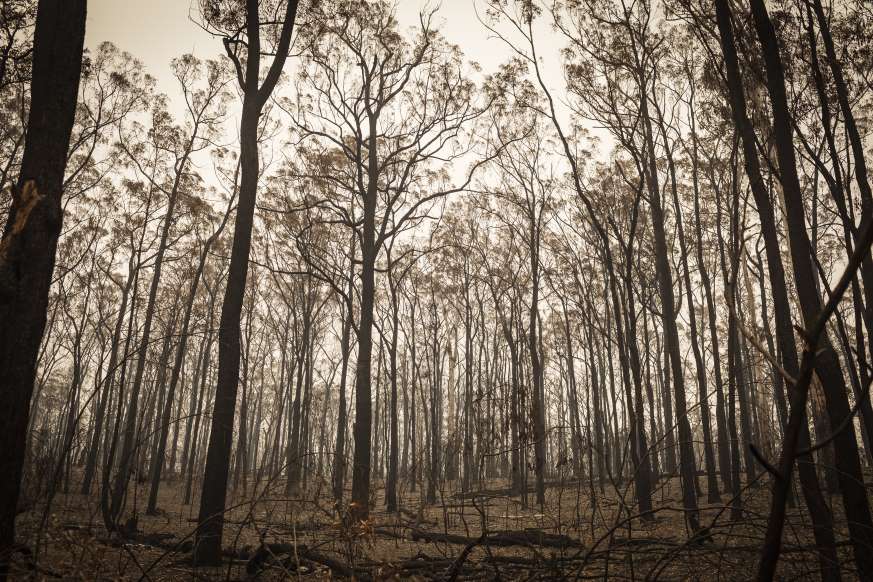
Scientists claim the summer of the 2019 fire is different from those in the past. These fires burned in areas which impeded large fires and acted as a natural barrier for protection.
Animals survived in Australia for a long time. The oldest fossil of a marsupial found in Tingamarra, Queensland, is fifty-five-million-years old. Could the unthinkable happen with many of these creatures facing extinction in their home habitat?
A Professor of Australian biodiversity at the University of Sydney, Prof Chris Dickman, co-wrote a report in 2007 for the World Wide Fund for Nature (WWF). He estimated every square of bushland roughly the size of a rugby pitch, or one hectare, was home to 17.5 mammals, 20.7 birds, and 129.5 reptiles.

The summer fires of 2019 burned ten-million hectares.
It is thought almost half a billion animals have died in the fires. But that figure could go much higher.
Worse still, this total does not include frogs, fish, bats, and invertebrates.
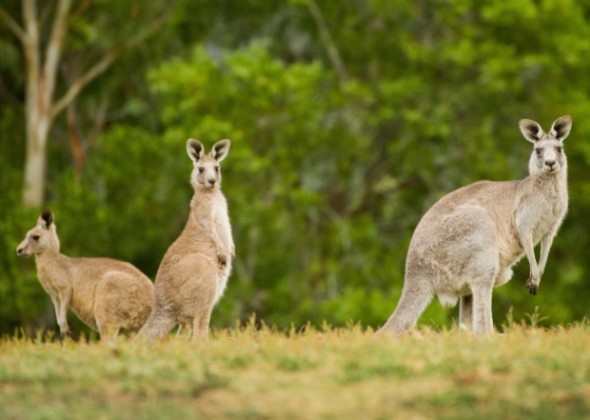
Larger species, kangaroos and emus could outrun a fire, unlike slower animals such as kolas, greater gliders, and potoroos. While larger animals may survive the initial flames, their future is of concern.
The long span of scorched earth is a habitat not found anywhere else in the world. The loss of hundreds of billions of insects is worrying ecologists. The invertebrates, which include butterflies, spiders, and earthworms, are vital for soil health and pollination, not to mention essential food for birds and marsupials.

If these habitats are destroyed, and the insects are gone, it is feared more animals will die.
The koala population is of the biggest concern. The arboreal marsupial and icon of Australia was hunted to extinction by fur traders in South Australia and Victoria. South-eastern Queensland populations have dramatically reduced by urban expansion. The largest colonies were in the fires zones of NSW.
Estimates put the number of koalas killed by fires at eight-thousand, but an exact figure will never be known.
The loss of human life, animals, and ten million hectares of natural habit burned in the fires is a crisis that will stay in the minds of Australians for generations

In 1996, gunman Martin Bryant shot and killed thirty-six people in Port Arthur, Tasmania. The mass-killing so shocked the nation that less than a month later, legislators introduced strict firearms control, including bans on fully automatic and semiautomatic weapons. Paul Bassat, a co-founder of the employment website SEEK, called the 2019 summer fires a “Port Arthur moment.”
Aggressive action similar to those enacted to gun-law changes in 1996 needs to happen immediately. Political leadership in both the Federal and State governments must see the uptake of renewable energy to reduce carbon emissions.
Dr. Schott, the chair of the Energy Security Board, told the Sydney Morning Herald and The Age, “Solar is generating more than gas, wind-generation more than brown coal. With all of that said, we are still burning a lot of coal.”
Back in 1988, the New York Times featured an article outlining a warning to the US Congress by James Hansen, director of NASA’s Goddard Institute for Space Studies. Hansen was 99 percent confident there would be a spike in global temperatures. He said of the increased levels of greenhouse gas that it would have, “Implications other than for creature comforts.”
Some thirty years later, Peter Harmer, chief executive of the IAG insurance group, released a report showing ‘the climate is changing more quickly than many predicted’.
During the last one-hundred years of this changing climate, ninety-six percent of the koala population has vanished.
The San Diego Zoo is by far the most successful breeding colony of koalas outside Australia. The Great Plains Zoon in Sioux Falls has another koala population. There are forty-nine koalas living in Japan and a further twenty in China. Edinburgh Zoo is home to the UK’s koalas.
A group called Koala Relocation Society is pushing for marsupial colonies to relocate in New Zealand with its thirty-thousand hectares of eucalypts. The group claim koalas are ‘functionally extinct’ in Australia while numbers could thrive in New Zealand.

Unless the current government takes decisive action to stop environmental degradation, the absurd notion that future generations of Australians must travel abroad to see their native animals could become a reality.
Featured photo by Chris Hopkins


How ironic. We might have to travel overseas to see a koala.
I think New Z is a great relocation option, although they are not happy with the consequences of the invasion of the possum, are they?
LikeLiked by 1 person
Thanks for your comment. The article was a tongue-in-cheek look at a serious situation. Since European settlement, many species have disappeared. There are some in this climate-denying government who think catastrophic fires would not occur if logging was allowed in National parks and nature reserves–a sanctuary in rapidly disappearing habitats. The fate of Australia’s unique faunas is a concern.
LikeLiked by 1 person
I appreciate your comment, AJ. Thank you. There was a deliberate movement back one to two decades ago in Australia to get right wing conservatives – predominantly evangelical ones in parliament. They were concerned about the direction of Australian society and decided to do something about it. The result is the right wing of politics is dominated by these folk who believe the planet is here for us to plunder and anything that looks towards caring for the environment is essentially ‘locking up’ nature. Eco managament is a far more complex than that and managment needs to look holistically rather than a blanket decision to allow logging or not and can be one that supports jobs rather than eliminates them. It is hard to get these folk to consider any other viewpoint. Biodiversity is the big loser. The continued rise of the alt right is also complicating any shifting of this mindset. If you are interested in the big picture stuff, you might find this blog post interesting https://northerndragon.blog/2019/08/11/the-alt-right-playbook/
LikeLiked by 1 person